Recipes
Pellet Grill Brisket
The cut barbecue is judged on. A pellet grill removes the fire management, which leaves you three things to get right: the trim, the wrap and the rest.
By Mike M. · Last updated November 13, 2026 · How we pick
Trim the fat cap to a quarter inch, season with coarse salt and pepper, smoke fat side up at 225°F, wrap in butcher paper when the bark sets around 165–170°F, raise to 250°F, and finish at about 203°F when a probe slides in with no resistance. Rest at least two hours before slicing.
What a pellet grill changes
Brisket on a stick burner is a fourteen-hour fire-management exercise. On a pellet grill the temperature holds itself, which removes the hardest variable and leaves the parts that are actually about the meat. It is the single strongest argument for owning one.
The trade is smoke volume: pellet grills produce less visible smoke than a wood fire, so the smoke ring is often thinner. The flavor is still there. Running the first few hours at a lower temperature, when the meat is cold and takes smoke most readily, gets you most of the way.
At a glance
- Prep time
- 45 minutes trimming
- Cook time
- 10 to 14 hours for a 12-14 lb packer
- Smoker temp
- 225°F, raised to 250°F after the wrap
- Target internal temp
- 203°F internal, probe-tender
- Pellet flavor
- Oak or hickory; post oak if you can get it
- Serves
- 12 to 14 servings
The stall is not a malfunction
Between roughly 150°F and 170°F a brisket's internal temperature stops rising, sometimes for four hours. It is evaporative cooling — moisture leaving the surface carries heat away as fast as the grill delivers it, exactly like sweating.
You have two options and both are legitimate. Wait it out for the firmest bark, or wrap to push through it. Raising the grill temperature to fight the stall is the one thing that does not work; it dries the exterior without meaningfully speeding the center.
Butcher paper or foil
Foil is faster and holds more moisture, which softens the bark — the so-called Texas crutch. Pink butcher paper breathes slightly, so it moves you through the stall while keeping the bark firm. For a first brisket, foil is the more forgiving choice; once you care about bark, switch to paper.
Pellet Grill Brisket
Ingredients
- 1 whole packer brisket, 12 to 14 lb
- 1/4 cup coarse black pepper (16 mesh if you can find it)
- 1/4 cup kosher salt
- 1 tbsp garlic powder, optional
- Pink butcher paper or heavy foil, for wrapping
Method
1Trim the fat cap to a quarter inch
Trim the fat cap down to about a quarter inch and remove the hard deckle fat between the point and the flat, which never renders. Round off the thin edges of the flat so they do not burn. Work with a cold brisket — fat is far easier to cut firm.
2Season simply
Equal parts coarse salt and coarse pepper is the Central Texas standard and it is hard to improve on for beef this rich. Coat every surface, including the sides, and let it sit while the grill comes up.
3Smoke fat side up at 225°F
Set the grill to 225°F and put the brisket on with the fat cap facing up, point end toward the hotter side of the chamber if yours has one. Leave it alone for the first several hours — this is when the bark forms.
4Wrap when the bark is set
Around 165-170°F, usually 6-8 hours in, the bark should be dark and firm enough that it does not smudge when you touch it. Wrap tightly in butcher paper, which lets some moisture escape and keeps the bark firm, or foil, which is faster but softens it.
5Raise to 250°F and finish
Put the wrapped brisket back on and raise the grill to 250°F. The smoke has done its work by now; the rest is a heat job, and the extra 25 degrees saves hours.
6Cook to probe-tender, around 203°F
Start checking at 195°F. A probe should pass into the thickest part of the flat with no resistance. Temperature is the guide and feel is the decision — some briskets are ready at 198°F and some need 207°F.
7Rest for 2 hours minimum
Vent the wrap for a few minutes to stop the cooking, then rest the brisket, still wrapped, in a dry cooler for at least 2 hours. This is not optional. A brisket sliced straight off the grill loses its juice onto the board and goes from excellent to ordinary.
8Separate, then slice across the grain
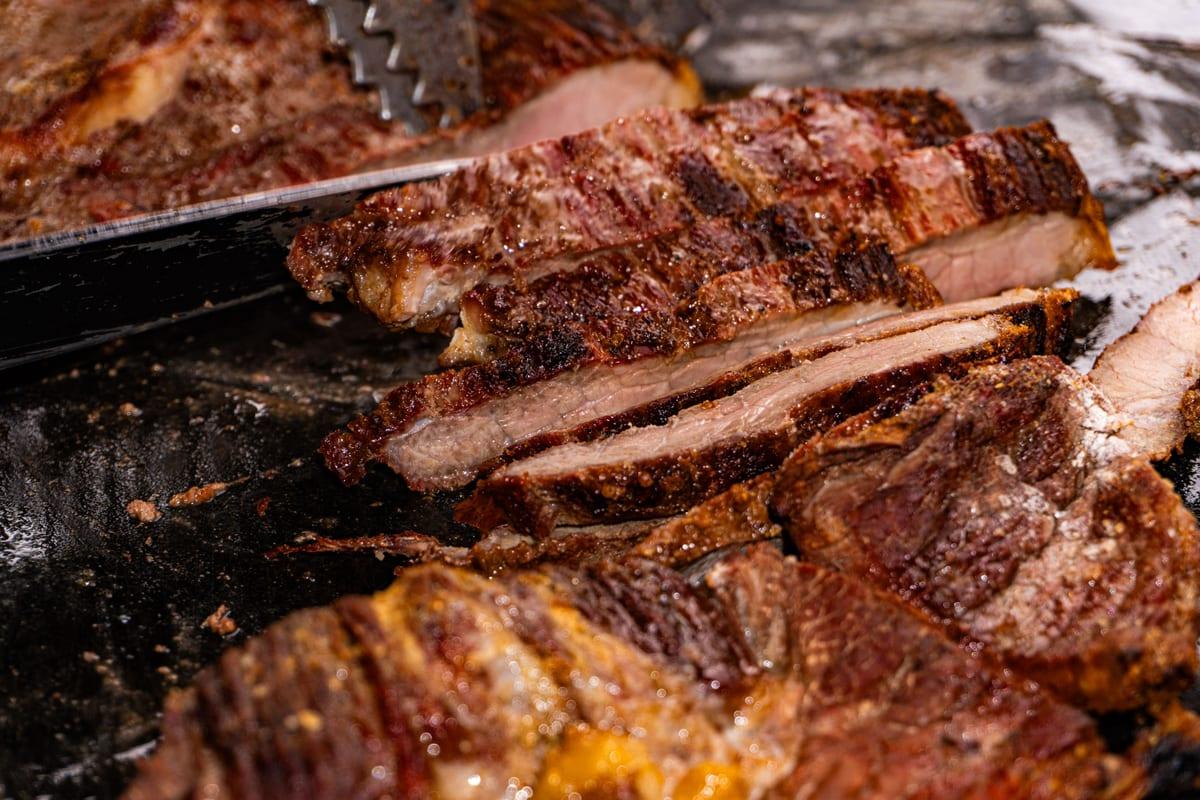
Separate the point from the flat — their grains run in different directions. Slice the flat across the grain at about pencil thickness; cube the point for burnt ends or slice it thicker.
| Packer weight | Approximate time | Cook to |
|---|---|---|
| 8-10 lb | 8 - 11 hr | 203°F, probe-tender |
| 10-12 lb | 10 - 13 hr | 203°F, probe-tender |
| 12-14 lb | 11 - 14 hr | 203°F, probe-tender |
| 14-16 lb | 13 - 16 hr | 203°F, probe-tender |
Times are a planning guide, not a timer. Every cut stalls differently, so cook to internal temperature and treat the clock as a rough estimate.
Plan for the cook taking longer than the chart says. Briskets stall unpredictably, and the only recovery from being late is a long rest in a cooler, which a brisket tolerates happily for several hours. Being early is easy to manage; being late is not.
Gear for this cook
- Pellets: best pellets for brisket
- Thermometer: the thermometers worth owning — an instant-read is the one tool this cook genuinely needs.
- Grill: the best pellet smokers
A 12-14 lb packer needs real grate space and a hopper big enough for a 12-hour cook. Hopper capacity matters more than you expect here — running out at 2am is the classic failure.
#ad Those pages carry affiliate links and live prices — how this site is funded.
Cook this next
The cheap rehearsal for everything on this page.
Same long-cook logic, far more forgiving.
Wrapping, explained on a six-hour timescale.
Questions people actually ask
How long does brisket take on a pellet grill?
Roughly 11 to 14 hours for a 12–14 lb packer at 225°F, raised to 250°F after wrapping, plus a rest of at least two hours. Cook to about 203°F and probe-tender, not to the clock.
Fat side up or fat side down?
Fat side up on a pellet grill. The heat source is below and indirect, and the fat cap on top bastes the meat as it renders. On a cooker with fierce bottom heat the argument flips, but that is not how a pellet grill works.
Why is my brisket dry?
Usually one of three things: it was pulled before the connective tissue rendered, it was sliced without a long enough rest, or the flat was trimmed so lean it had no fat left to carry it. The rest is the most commonly skipped step and the easiest to fix.
Do you need to wrap a brisket?
No, but most people should. Unwrapped gives the best bark and takes the longest. Wrapping in butcher paper at about 165–170°F is the usual compromise: it shortens the cook by hours and keeps the bark mostly intact.
Sources
Read next
Recipes
Smoked Chuck Roast
250°F, wrap at 165°F, cook to 203°F. Brisket texture, less risk.
Recipes
Pellet Grill Pulled Pork
225°F, wrap at 165°F, 203°F probe-tender. Hard to get wrong.
Recipes
Pellet Grill Ribs: the 3-2-1 Method
3 hours smoke, 2 wrapped, 1 glazed. All at 225°F.
Wood Pellets
The Best Wood Pellets for Brisket
Long cooks punish strong wood. The right bags for brisket.