Best Pellets Overall
The Best Wood Pellets for Smoking
Eight BBQ pellet bags ranked on flavor, ash and cost per pound.
Read the guide →
Which bag to buy, what it tastes like, and what it costs per cook.
Use food-grade BBQ pellets, never heating pellets. Cooking pellets are 100% hardwood with no binders, additives or fillers. Heating pellets for a pellet stove may contain softwood, bark or glues you do not want in your food. The price difference is large enough to tempt people, and the consequence is food cooked over the wrong fuel.
Every bag on every page in this section is explicitly sold as a BBQ or smoking pellet by its manufacturer, and we cite the listing.
This section answers three things: which bag to buy generally, which wood suits which food, and whether your grill brand changes the answer. It does not, mostly — which is itself worth knowing.
| If you are asking | Read |
|---|---|
| Which pellets should I buy? | Best wood pellets for smoking |
| What is the cheapest decent option? | Best budget wood pellets |
| Which wood for brisket, ribs, pork, chicken, beef? | The five flavor-match pages |
| Does my grill brand matter? | The three brand-fit pages |
| What does each wood actually taste like? | Wood pellet flavors explained |
| What is actually in the bag? | Hardwood vs blended pellets |
This is the single most useful thing in this section, and almost nobody prints it. Pellets are sold in 18 lb, 20 lb and 40 lb bags, and the cost per pound differs enormously:
Switching from premium 18 lb bags to 40 lb bulk bags roughly halves your fuel bill. Over a season of weekly cooking that is real money. The only constraint is dry storage — and bulk buying only saves money if the pellets stay dry, because damp pellets crumble and jam augers. A sealed 40 lb dispenser pays for itself quickly.
The rule that matters more than any brand preference: the longer the cook and the milder the food, the milder the wood should be.
A brisket spends twelve hours absorbing smoke, so a strong wood used throughout turns bitter — which is why mesquite, excellent on a steak, is the classic brisket mistake. A chicken thigh spends an hour, so even hickory stays pleasant. Oak and hickory work across the whole range, which is why they are the default barbecue woods.
Cherry is the one people overlook, and it does something no other wood does as well: it produces a deep mahogany color on pork and poultry. If your ribs taste right but come off pale, that is a wood problem and cherry is the answer.
Most people buy five or six flavors, use two, and let the rest go soft in a garage. Three bags cover everything:
Add oak only if you want to blend your own and stretch an expensive fruitwood. You can mix pellets freely in the hopper, and hickory plus cherry at roughly 50/50 is the classic competition profile.
If your complaint is that your pellet grill does not produce enough smoke, changing bags is the least effective fix available. In order of what actually works: cook at 225°F instead of 275°F (free), add a smoke tube (a few dollars), then switch to a stronger wood. Pellet grills produce their heaviest smoke at low temperatures, and temperature is the lever.
12 pages, each with live Amazon prices on every pick.
Best Pellets Overall
Eight BBQ pellet bags ranked on flavor, ash and cost per pound.
Read the guide →
Best Budget Pellets
Cheapest pellets worth burning, ranked by cost per pound.
Read the guide →
Flavor Guide
Every BBQ wood by smoke strength, and what each one suits.
Read the guide →
Blend vs Single Wood
Single-wood, blended and 'flavored' are three different products.
Read the guide →
Best for Brisket
Long cooks punish strong wood. The right bags for brisket.
Read the guide →
Best for Ribs
Five-hour cooks where color matters — why cherry belongs here.
Read the guide →
Best for Pork
Pork takes fruitwood best — and the cut changes the answer.
Read the guide →
Best for Chicken
Chicken is easy to over-smoke. Mild fruitwood, hotter cook.
Read the guide →
Best for Beef
The only meat that takes mesquite — and only on short cooks.
Read the guide →
Best for Pit Boss
Any brand fits — what matters is the 30 lb hopper economics.
Read the guide →
Best for Traeger
Traeger's own bags cost the most per pound. Here's what else works.
Read the guide →
Best for Z Grills
No brand question — just what suits a PID board and 28 lb hopper.
Read the guide →
Yes. Every brand we cover states compatibility with all pellet grills — Traeger pellets work in a Pit Boss and vice versa. Brand matching is a marketing preference, not a technical requirement.
BBQ pellets are 100% food-grade hardwood with no binders or additives. Heating pellets for a pellet stove may contain softwood, bark or glues. Never put heating pellets in a grill.
A competition blend — typically maple, hickory and cherry. It suits almost everything and is hard to overdo while you learn the grill. See wood pellet flavors explained.
They do not spoil, but they absorb moisture, swell and crumble — and crumbled pellets jam augers. Kept sealed and dry they last indefinitely. See how to store wood pellets.
Browse the other sections: Pellet Grills, Comparisons, Reviews, Covers & Accessories, Guides.
Our everyday pick
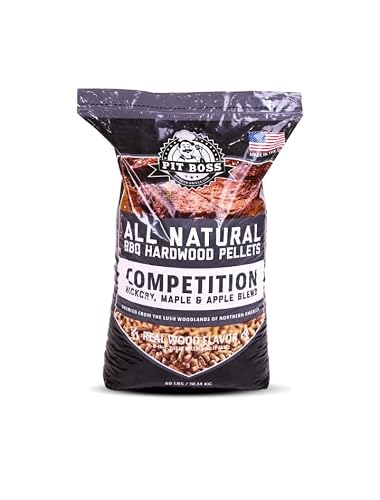
40 lb of 100% natural hardwood with no added scents, sprays or glues — the lowest cost per pound we track, in a competition blend that suits almost anything. If you only buy one bag, buy this one and keep it dry.
Price as of November 7, 2026. #ad how this is funded